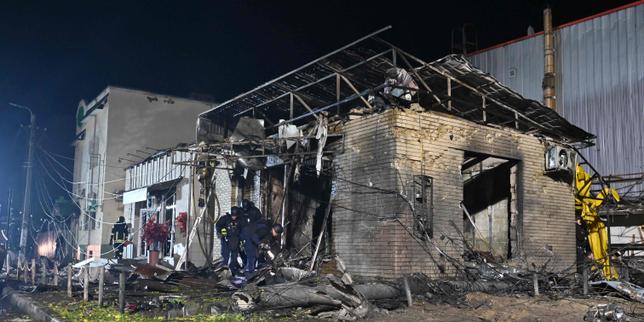
Air raid sirens don't stop life in Ukraine. People still buy groceries, kids go to school, and families gather. Then a missile hits. Three people died and twenty-five others suffered injuries when a Russian strike slammed into Pisochyn, a community just outside Kharkiv.
Among the dead was a sixteen-year-old boy. A nineteen-year-old woman and a fifty-one-year-old woman also lost their lives in the blast. The missile didn't hit a military base or a trench network. It struck right next to a grocery store and nearby residential buildings.
Kharkiv lives under constant threat. Proximity to the front line means warning times are often measured in seconds rather than minutes. Local police and emergency services rushed to the scene immediately following the attack, pulling the wounded from the debris and tending to shocked survivors. Among the twenty-five injured victims, medical teams reported young children needing urgent care.
This tragedy fits into a broader, brutal pattern of escalation across the country. Official figures released by Ukrainian authorities reveal staggering weekly statistics. In just one week, Russian forces deployed roughly one thousand four hundred and fifty aerial bombs, seventy-five missiles of various types, and over one thousand six hundred attack drones. About sixty percent of those drones rely on jet propulsion, making interception exponentially harder for local air defense units.
Why does Kharkiv remain such a primary target? Strategic geography plays a massive role. As Ukraine's second-largest city, its industrial footprint, transport hubs, and dense civilian population make it a persistent target for attrition tactics. Moscow's strategy relies heavily on wearing down civilian morale through continuous aerial bombardment, destroying local infrastructure, and forcing daily life into underground shelters.
The psychological toll on survivors is immense. Communities like Pisochyn are left picking up the pieces after every strike. Makeshift memorials grow outside damaged apartment blocks. Neighbors share resources, check on elderly residents, and try to rebuild shattered windows before winter settles in. International aid organizations and local volunteers do what they can, but the sheer volume of strikes overwhelms regional response teams.
Support from international partners remains critical for survival, yet geopolitical friction adds uncertainty. While diplomatic maneuvers and unverified ceasefire claims float through international headlines, the reality on the ground in Kharkiv remains unchanged. Air raid sirens sound daily, interceptors streak across the sky, and civilians bear the heaviest cost of an ongoing war of attrition.
Stay informed by following verified local reports, supporting humanitarian efforts operating directly in eastern Ukraine, and recognizing the daily resilience of civilians living near the front lines.



