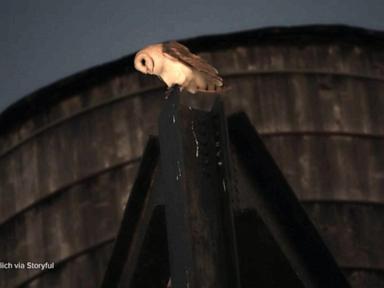
New York City usually thrives on chaos, concrete, and constant motion. But right now, crowds are standing on Upper West Side sidewalks staring quietly up at a water tower. They aren't looking for celebrity sightings or architectural marvels. They are watching barn owls.
This isn't just another casual pigeon sighting or a stray hawk. Experts note this marks the first documented instance of a barn owl family nesting in Manhattan in modern history. Two adult owls and as many as six juveniles have taken over a wooden water tower on West 75th Street near Central Park. For a city that prides itself on seeing everything, these ghostly, heart-faced nocturnal hunters stopped everyone in their tracks.
How the Upper West Side Barn Owls Discovered the Concrete Jungle
Word got out when local residents heard strange, raspy screeches echoing through the night air. Some neighbors initially thought someone was screaming outside. It turned out to be hungry juvenile barn owls begging for food.
Elisabeth Williams, a resident living nearby, first spotted an owl on an apartment windowsill before tracing the activity up to the rooftop water tower. When local birders and ornithologists verified the discovery, excitement spread fast. In a metropolis where you normally have to visit a zoo to encounter rare wildlife, having a wild raptor family set up housekeeping right above a residential street feels surreal.
Why choose Manhattan? Urban areas offer a massive supply of rodents. But barn owls are notoriously secretive and sensitive to human disturbance. Nesting out in the open on a busy Manhattan block goes against everything we know about their typical behavior. They usually prefer quiet barns, abandoned silos, or remote hollow trees. Choosing a noisy, high-traffic NYC rooftop proves that nature adapts in ways experts don't always expect.
The Real Threats Facing Manhattan's Newest Residents
While crowds gather nightly with high-end cameras and binoculars, urban wildlife conservationists are voicing serious concerns. City life poses brutal hazards for apex predators.
Rodenticide is the biggest danger. Pest control methods in dense urban environments often rely heavily on rat poison. If a barn owl catches a poisoned rat, the toxin moves up the food chain, spelling disaster for the predator. Bird enthusiasts and local conservation advocates are already urging local building managers to rethink chemical pest control in the neighborhood to keep these rare raptors safe.
Traffic collisions and glass towers also present daily risks for young owls learning to hunt and fly between skyscrapers. After the tragic loss of Flaco the owl, New Yorkers are hyper-aware of how vulnerable city birds can be.
Why This Moment Matters for Urban Nature
City dwellers often feel entirely disconnected from the natural world. Concrete blocks out the sky, and subway lines drown out bird songs. This family of barn owls offers a powerful reminder that wild ecosystems still find cracks in the urban grid.
People are lingering on street corners for hours at dusk, waiting for a ghostly white wing to flash against the evening sky. Neighbors who didn't know each other are swapping notes and binoculars. It provides a much-needed antidote to daily burnout.
If you happen to be in the neighborhood at dusk, head toward West 75th Street and look up. Keep your distance, respect the birds, and hope this unexpected Manhattan experiment turns into a long-term residency.
Watch David Muir's report on the Manhattan barn owls
This video segment provides an on-the-ground look at the rare barn owl family capturing the attention of New York City residents.



