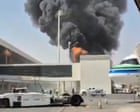
Twelve people are dead. Hundreds more are injured. And Saudi Arabia's premier aviation hub, King Khalid International Airport, sits completely closed after a devastating missile strike ripped through its terminals.
If you thought the regional conflict was contained, think again. The latest assault by Yemen's Houthi movement has escalated the war far beyond maritime skirmishes in the Red Sea. Now, civilian airspace itself is ground zero. Houthi military spokesman Yahya Saree didn't mince words when he issued a blanket warning to travelers and international airlines to steer clear of all Saudi airports, save for Mecca and Medina.
The strategy is direct and brutal: airport for airport, siege for siege.
Breaking Down the Riyadh Attack
The strike on King Khalid International Airport wasn't an isolated accident. It marked the third time this week that projectiles pierced Saudi air defenses to target the capital's busiest transport artery. Terminals 3 and 4—packed with passengers waiting for domestic and regional flights—took the brunt of the impact.
The casualties reflect an international toll. Among the 12 dead are four Saudi citizens, two Bangladeshi nationals, an American, an Egyptian, a Jordanian, a Palestinian, a Syrian, and a Sudanese worker. That mix of nationalities turns a localized political conflict into an international crisis overnight.
Airlines are already reacting. Major carriers including Air India, FlyDubai, Lufthansa, and Pakistan International Airlines suspended flights across Saudi airspace months ago as regional tensions flared, but this latest ultimatum turns temporary caution into a permanent rerouting headache for global aviation.
Washington Weighs In As Pressure Mounts on Trump
Down in Washington, the pressure valve is spinning wildly out of control. US President Donald Trump admitted that the White House is actively evaluating whether American forces should join Saudi Arabia in direct air strikes against Houthi strongholds in Yemen.
Until now, the US response has been hesitant. Saudi Crown Prince Mohammed bin Salman requested direct military intervention weeks ago, but Washington only offered intelligence sharing and targeting assistance. Why the hesitation? American military stockpiles are heavily depleted after months of operations in Iran, and the political cost at home is staggering. Gasoline prices across the United States have surged roughly 47% since the Iran conflict began earlier this year, dragging presidential approval ratings down to 37% just weeks before the midterms.
Yet, with an American citizen among the dead in Riyadh, the political calculus changes fast. When domestic citizens start perishing in foreign transport hubs, standing on the sidelines becomes politically untenable.
The Red Sea Blockade and the Ground War
To understand why the airport strikes are happening now, you have to look at the ground war playing out in Yemen.
Over the past month, Saudi-backed coalition forces launched a major counter-offensive to dislodge Houthi rebels from critical choke points, specifically the Bab al-Mandab strait. The Houthis seized control of strategic Red Sea islands back in September, tightening a stranglehold on global shipping lanes. With the Strait of Hormuz effectively shut down due to broader hostilities, the Red Sea corridor represents a lifeline for Saudi oil exports.
The Houthi leadership views the Saudi-led coalition's ground campaign as an act of war that demands total reciprocity. The Houthi-run health ministry reports that nearly a hundred Yemenis have died in coalition airstrikes over the past five weeks, creating an endless cycle of retaliation that neither side is willing to pause.
International Reactions and the Global Ripple Effect
Global leaders are scrambling to contain the fallout. United Nations Secretary-General António Guterres called the strikes a clear violation of international law, insisting that civilian infrastructure must remain untouched.
European Union chief Ursula von der Leyen echoed those sentiments, blaming Iran's proxies for pushing the entire region into a dangerous spiral of violence that threatens global supply chains. While Brussels has offered strong words, tangible military assistance remains fractured. Germany and France have largely demurred on direct military aid, while the United Kingdom stepped in by deploying RAF Voyager refueling aircraft and air defense systems to help protect Saudi skies and secure vital energy corridors.
Meanwhile, neighboring Iraq issued stark warnings that the widening conflict threatens absolute regional instability.
What Comes Next for Air Travel and Trade
If you are planning a trip through the Middle East, the landscape has shifted permanently over the past week. Commercial aviation through Saudi airspace is no longer operating under standard risk assumptions. Airlines are treating regional flight paths as active conflict zones, and insurance premiums for carriers flying anywhere near the Arabian Peninsula are skyrocketing.
The message from the Houthi leadership is clear. They intend to maintain pressure until the Saudi-led coalition halts its operations in Yemen. Until diplomatic breakthroughs materialize—or until a massive military campaign alters the balance of power on the ground—travelers and logistics planners must treat Saudi airspace as a high-risk theater of operations.
Prepare for extended flight times, volatile ticket pricing, and sudden route cancellations as the region navigates its most dangerous chapter in years.



