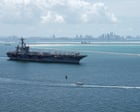
Nearly a year at sea leaves deep scars. When the USS Abraham Lincoln pulls into San Diego, it marks the end of an exhausting deployment that tested the limits of American sailors and the military establishment.
You do not spend twelve months in continuous high-threat operations without breaking things. For the roughly 5,000 personnel aboard this nuclear-powered aircraft carrier, home hasn't been a physical place for nearly a year. It has been a steel box filled with mechanical failures, water shortages, and relentless combat stress tied directly to the US campaign against Iran.
A Mission Extended Beyond the Breaking Point
The deployment started innocently enough last November. The Lincoln left San Diego with orders heading toward the Pacific. Then reality intervened. When the war with Iran erupted in late February, the Pentagon scrambled assets. The carrier was redirected straight into the Middle East theater, anchoring an intense operational pace that did not let up for months.
Instead of a routine rotation, the crew faced repeated extensions. They stayed on station in the region until late August, waiting for the USS George Washington to finally provide relief. By the time the Lincoln turned its bow back toward California, the human cost had mounted.
Public scrutiny spiked in August when reports leaked detailing abysmal living conditions. Plumbing systems failed. Fresh water grew scarce. Morale plummeted. Most alarming were the reports of sailors attempting to jump overboard, a grim indicator of a psychological crisis unfolding behind gray steel hulls.
The Clash Between Political Spin and Navy Reality
Washington reacted predictably. Defense Secretary Pete Hegseth dismissed reports of deteriorating conditions, calling them entirely misrepresented. When pressed about whether the deployment dragged on too long, Donald Trump offered a blunt assessment: "Not nearly long enough."
That kind of rhetoric stings when you are living on reduced water rations thousands of miles from your family.
Behind closed doors and official statements, the numbers tell a darker story. Acting Navy Secretary Hung Cao later confirmed that eight service members from the Lincoln strike group attempted suicide during this grueling stretch.
Admirals tried to cushion the blow. Admiral Brad Cooper of US Central Command noted that the Lincoln actually held lower mental health case numbers than some peers, yet he conceded an uncomfortable truth. Long deployments are uniquely brutal, and every sailor handles compounding stressors differently.
Accountability on the Horizon
Politicians are taking notice, too. Representative Sara Jacobs visited the ship in late September, returning with stern warnings. While she welcomed the crew back to San Diego, she made it clear that accountability will not end at the pier. Demands for an Inspector General investigation and a House Armed Services Committee hearing are picking up steam. Congress wants to ensure no other crew is pushed this far without a safety valve.
Just days before the arrival, Hegseth flew out to meet the crew, praising their endurance and handing out presidential unit citations for extraordinary heroism in action. Medals are nice, but they do not replace broken trust or fix systemic fatigue.
The ship is docked now. Families are reuniting on the pier. But the questions raised by this historic deployment will linger long after the sailors unpack their seabags. If the military wants to maintain an edge in prolonged conflicts, it has to figure out how to keep the people inside the machine from snapping first.



