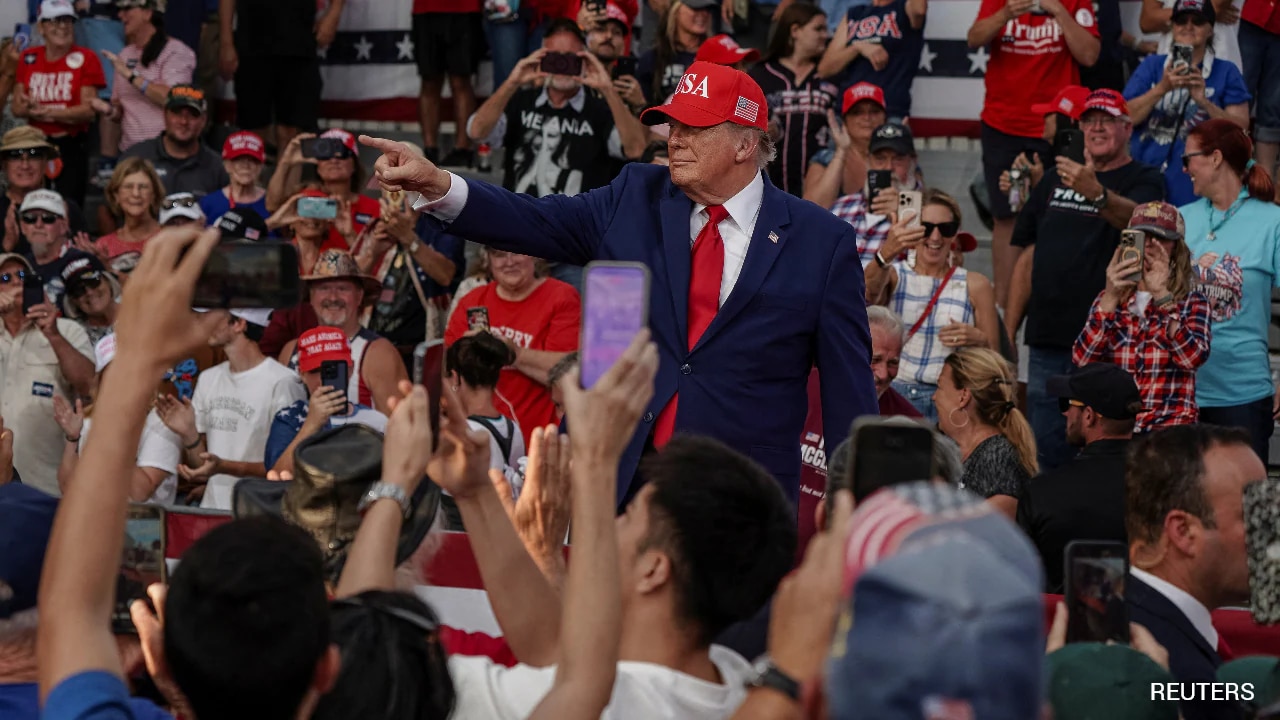
Donald Trump loves a reliable punchline. During a campaign stop at the Dalton Municipal Airport hangar in Georgia, the former president leaned into a well-worn bit about how to address anyone from the Middle East. If you're stuck, just guess Mohammad. According to him, you'll have a sixty-five percent chance of landing on the right moniker. It is a joke he has recycled for years, framing it as a casual observation about cultural demographics.
This time, the comment served as a setup to mock the Iranian political apparatus. Standing before midterm crowds while stumping for Republican candidates, Trump claimed that Iran is the lone nation where nobody actually wants the presidency. He then acted out conversations asking various imaginary people named Mohammad if they wanted the job. Masoud Pezeshkian took office as Iran's president back in 2024, but accuracy has never been the primary currency of campaign trail humor. The Georgia audience offered a mostly muted response to the bit. Still, the underlying rhetoric points straight back to a long-running pattern of political showmanship that treats global affairs and cultural identities as props.
When politicians reduce entire regions and populations to a punchline, they are rarely speaking to international nuance. They are playing directly to domestic political scoreboards. In the middle of an intense midterm election cycle, weaponizing cultural tropes serves a clear purpose. It rallies a base that responds to anti-establishment posturing and cultural friction. But beneath the campaign trail wisecracks lies a more serious policy backdrop that rarely gets solved by mocking names.
Let us look at the actual geopolitical stakes. Trump used the same rally to reiterate his hardline stance on Iran's nuclear aspirations, referencing the military actions taken by the United States and Israel to disrupt Tehran's atomic infrastructure. That is heavy policy terrain. It involves military strategy, intelligence assessments, and fragile regional alliances across the Middle East. Yet public discourse often gets flattened into quick soundbites about naming conventions and leadership jokes.
Civil rights advocates and Muslim community organizations have spent years pushing back against this style of rhetoric. Groups like the Council on American Islamic Relations frequently point out that casual stereotyping from high-profile political figures trickles down into everyday bigotry. When political leaders treat names associated with Islamic heritage as a generic placeholder for an entire geographic group, it reinforces othering. It sends a signal that certain communities are permanent outsiders, regardless of citizenship or integration.
During this particular campaign stretch, Trump has also turned his rhetorical fire toward specific high-profile figures, including Minnesota Representative Ilhan Omar and Senate candidate Abdul El-Sayed. By tying these localized political attacks to broader foreign policy targets like Iran, the strategy creates a continuous feedback loop of grievance. It blends domestic political battles with international tensions, making complex diplomatic challenges look like backyard fights.
Humor in politics is rarely just humor. It reveals what a speaker thinks their audience will reward. When a crowd responds with silence rather than roaring laughter, it suggests even loyal supporters sometimes recognize when a routine has worn out its welcome.
If you want to understand where American foreign policy toward the Middle East is heading, pay attention to the actual diplomatic maneuvers, the ongoing enforcement of sanctions, and the military postures of regional actors. Do not look for answers in stand-up routines on airport tarmacs. Real geopolitical stability requires deep institutional focus, not recycled jokes about statistical naming probabilities. Look past the stage banter and examine the actual policy choices shaping the future.



