You expect trees to grow upright. Gravity pulls them toward the sky, roots anchor them deep below, and centuries of botanical instinct dictate a vertical climb. But nature loves a good plot twist. In the coastal town of Newcastle, County Down, a 150-year-old wych elm decided to ignore the rules completely. It grew sideways.
That bizarre, horizontal trunk just earned it the crown for the UK Tree of the Year 2026. Run by the Woodland Trust, the annual competition highlights ancient specimens with incredible stories. While other nominees boasted hollowed-out trunks or gravity-defying roots perched on church towers, the Northern Ireland marvel took the prize for its sheer stubbornness against the elements.
Let's look at why this specific tree captures what modern conservation is actually about.
Surviving the Worst of Dutch Elm Disease
We aren't just talking about a funny-looking tree. We are talking about a survivor.
Dutch elm disease has wiped out an estimated 30 million elms across the UK since it swept through the country. Entire woodlands vanished. Hedgerows were stripped bare of their native canopies. Yet, this 150-year-old Newcastle wych elm stood its ground.
Planted back in the mid-19th century as part of a protective row along the promenade to shield local streets from brutal Irish Sea gales, most of its companions were eventually chopped down during urban redevelopments. This lone specimen survived the chainsaw, urban sprawl, and a fungal plague that decimated its entire species.
It's a biological anomaly. While scientists continue to study why certain individual trees possess genetic resistance to Ophiostoma novo-ulmi, seeing one thrive horizontally adds a whole new layer of wonder.
The Physics of a Sideways Tree
Why did it grow sideways? Blame the wind.
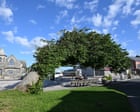
Constant, fierce gales blasting off the Irish Sea didn't break the young wych elm; they molded it. Instead of snapping under pressure, the wood adapted. Over decades, the trunk stretched out almost horizontally, offering a low-slung, sweeping canopy that now shades park benches and gives tired walkers a spot to rest.
May Chemais, the ancient tree inventory lead for the Woodland Trust, put it best when she noted that the tree mirrors human endurance. We have all faced hardships that shape our trajectories. Seeing a living organism bend dramatically without breaking hits close to home.
John Martin, the Trust's director in Northern Ireland, grew up visiting Newcastle. He remembers catching glimpses of the trunk out of the corner of his eye and doing a double-take. It breaks your mental model of how the natural world operates.
Other Contenders That Missed the Crown
To truly understand why the bendy elm won, you have to look at the fierce competition it faced this year. The shortlist showcased the bizarre ways British and Irish communities intertwine with arboreal history.
Take the Crowhurst Yew in Surrey. Back in 1820, local villagers literally hollowed out the trunk to build a makeshift parish meeting room inside the tree. A storm destroyed the roof in 1845, but the yew kept growing, leaving the original wooden doorway intact.
Then there is the Culmstock Yew in Devon, which perches stubbornly on top of a 20-meter-high church tower, rooted in mortar and stone where no tree has any business surviving.
Compared to architectural oddities and church-roof tenants, the Newcastle wych elm won on pure attitude. It didn't need human carving or strange masonry; it just took a beating from the ocean wind, refused to die of Dutch elm disease, and grew sideways out of sheer spite.
What Ancient Trees Teach Us About Local Resilience
We spend billions on engineered climate defenses, seawalls, and urban cooling initiatives. Sometimes, the best infrastructure is already rooted in the soil.
Older trees provide immense, measurable value to towns like Newcastle. They regulate microclimates, absorb stormwater, reduce urban heat island effects, and foster community pride. When a town rallies behind a crooked tree, it is investing in its own identity.
The Woodland Trust uses these competitions for more than just a public vote. Alongside the crown, they launched initiatives like the Igniting Innovation program, backing young people aged 16 to 25 with funding and mentorship to build projects that protect woods and wildlife.
Next time you walk past an old tree looking slightly worse for wear, remember the bendy elm of County Down. Growth doesn't always mean climbing straight up. Sometimes, surviving means bending with the pressure and refusing to let go.